The Caledonian Brewery

Virtual Brewery Tour

Click here to expand this imageYou'll be pleased to see that's it's only the brewing process where we insist on sticking to age old techniques. Our virtual tour is made up of superb panoramic views, interactive footage and video clips - so get involved and enjoy The Caledonian Brewery.


Ingredients

There are only four ingredients required to brew beer. And at The Caledonian Brewery, additives, chemicals and preservatives are strictly not part of these four.

The Barley

BarleyBarley is where beer gets its taste, appearance, body and much of its strength. So, naturally we ensure we use only premium quality barley which is grown locally in East Lothian.

The process of malting barley allows the starches to be broken down into sugars so that a fermentable liquid can be produced. We tend to use up to four, five or six different malt combinations to produce our selection of beers.

The Hops

HopsStep foot into our hops room and you won't want to leave. Your nose will immediately tell you why hops are so integral in the brewing of great beer.

We only use whole hop flowers, whereas most breweries use processed or artificial hop oil. Essentially this translates into a fresher taste and more natural aromas being present in our beers.

There are two main qualities which hops adds: the refreshing aftertaste which is referred to as bitterness and the aroma which gives each beer its distinctive quality.

The Yeast

YeastYeast feeds on the sugars from the barley and converts them into alcohol and carbon dioxide – which is the process known as fermentation.

Breweries zealously guard their own particular strain of yeast to protect it from infection and mutation and the strain of yeast at Caledonian Brewery has been in continuous use since 1869.

The Water

WaterBreweries in Edinburgh were distinguished by the quality and characteristics of the local water.

The well at Caledonian Breweries still draws water from a depth of 200 metres.


Where you see this icon, click on the image to open up spectacular Panoramic views of the Brewery. QuickTime browser technology is required. Click here to download QuickTime for free.

The Brewing Process

To make the process easier, a good idea is to picture four rooms.

The Malting Room

MaltingsThis is where it all starts and as the name suggests, it is here that the barley is malted. It is steeped in water and allowed to germinate briefly. Then the process is suspended by drying or curing the grains, in a kiln, over hot air. The higher the temperature, the more colour and flavour is produced from the malted barley (e.g. Guinness) whereas lower temperatures produce beers with a lighter appearance and sweeter flavours (e.g. Deuchars).

Before moving to the next room, the barley is selected and milled to crack it. ( In case you were wondering, as strong as those hands look, the milling is not done by hand.)

The Mash Tun Room

Click here to view the Mash TunWhat you can see in this room is essentially three giant stainless steel saucepans. In brewing speech they're known as Mash Tuns. (That's Craig in the picture by the way. As you can see, a man who clearly had nothing better to do on that day.)

What happens next is that the cracked malt is fed into the Mash Tun along with hot water (known as “liquor” in the brewing trade).

This is a crucial part of the process. It is vital that the temperature is controlled as it is at this point that the malt starts to convert its starch into sugars which is what Bruce is up to at the Mash Tun.

Once in the tun, the ingredients are evenly mixed until they reach a porridge like consistency or mash.

Additional hot water is sprayed over the mash to ensure that all the sugars from the barley are washed into the liquid (called “wort”). Then the wort is drained off and sent to the brewing coppers for the next stage.

The Coppers

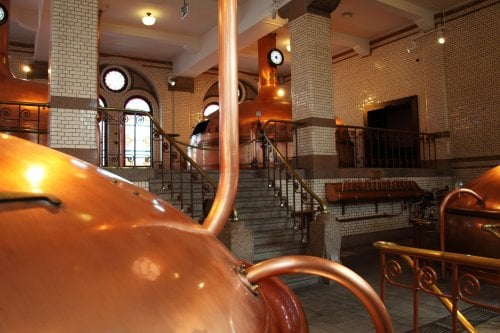
Click here to view the CoppersSo why do we go about the coppers so much? Have a look and see. They're just magnificent. They're all hand beaten and with a life expectancy of 1800 years, they'll easily outlive all of us, including you. And whereas other breweries use elements to heat the wort at this stage, we still use direct fired gas. The Coppers are also open and as you'll pick up from Bruce getting stuck in; this allows us closer control of the boil as we can see what's going on.

So from the Mash Tun, the wort is poured into the coppers. (We do realise from the footage that Bruce appears to be our only member of staff. In fact, we're a team of seventeen, but the rest of us were having a bad hair day.)

And next the hops are added but first they are selected and mixed. Bitter hop flowers are added early in the boiling process and aromatic hops are added at the end to ensure a unique aroma. The brewers' art is to balance the flavours of the malt and the hops.

Another area which differentiates us is our traditional method of dry hopping. We use a hop back and it's like a massive tea bag. The wort sits inside for ten minutes and absorbs the hops aromas which contribute considerably to our very distinctive flavours. Thereafter, it is cooled before being passed into open, square fermenting tanks.

The Fermenting Tanks

Click here to view the Fermentation TanksThis is the fun part. Here, the yeast is added. Seeing the yeast in different stages of fermentation is a bit of a science fiction experience. The yeast at this stage is literally feeding on the sugar present in the wort and converting it into alcohol and CO2.

This feeding goes on for three days. During which time the yeast bubbles, boils and even forms elongated protrusions. It rises quite dramatically and a very thick layer of sponge forms over the beer. Finally, it is hoovered off the beer and recycled.

Then the beer is left to mature in the conditioning tanks for between 20 and 15 days before being put into casks for delivery. (Take a look, it's not Bruce in this one.)

To be continued where a pint ends up in a bar near you.


Glossary - Find out more about the unique words and terminology used by brewersEnvironment - Brewers have always been avid recyclers. Find out more.Our History - We're over 130 years old. Find out how it all started.
 
 
Contact Us here Terms & Conditions